
The Initial recap posted is at the top and the details of the Q&A are below that.
LWPTSA Council successfully hosted a crucial School Board Candidate Forum on October 15, at the LWSD Resource Center. We extend our sincere gratitude to candidates Angela Meekhof, Susan Hughes, Aspen Richter, and Kim Martin for their thoughtful participation and engagement with our community.

Special thanks to Melissa Stone for moderating the evening with clarity and care. Her leadership helped guide a powerful conversation about accountability, transparency, and the future of our district.
The discussion was robust, covering critical areas including district priorities, academic standards (including high-cap programs), equity policies, and the long-term vision for student success.
Please take a few moments to fill out a feedback form for the forum.
We will be sharing a detailed analysis and the candidates’ full responses on these critical issues shortly. Please check our website for the update.
Questions? Email LWPTSA Council Advocacy Co-Chairs Marie-Therese Schambeck and Sushmita Srikant at Advocacy@LWPTSA.net.
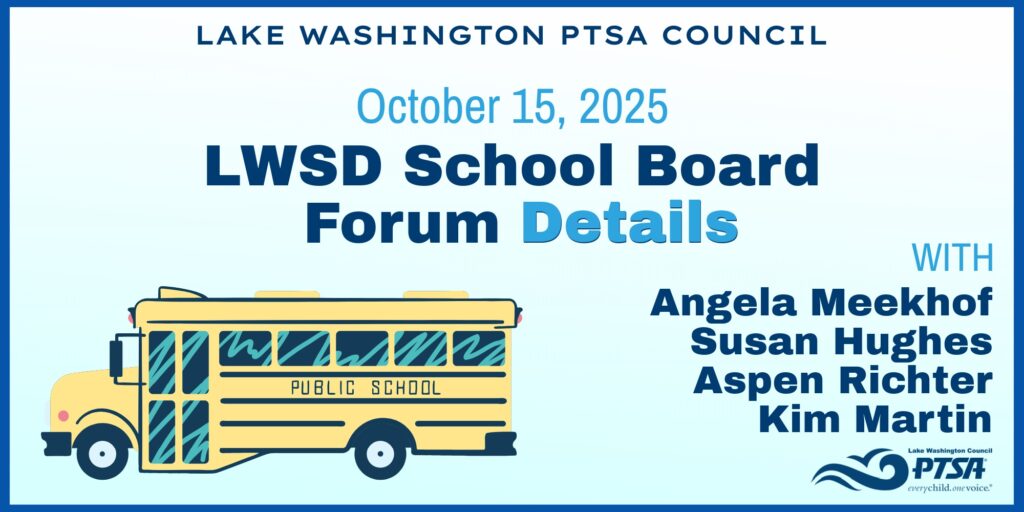
School Board Candidate Forum Details
Intro
National PTA is the nation’s oldest and largest child advocacy organization. It supports our state PTAs, who in turn advocate for issues most pressing to their individual state. Under state PTAs, the district councils support local PTAs.
At the Lake Washington School District PTA level, we support 44 PTAs and over 10,000 members. Along with your school PTAs, we support our students, families, and community. This event is one of the ways the LWPTSA Council works to inform our community.
Each candidate had 90 seconds to provide opening statements, 90 seconds to answer questions, and 90 seconds for closing remarks. We rotated who answered first.
Disclaimer: The draft answers below has been compiled by Sushmita Srikant (Co-VP of Advocacy) and Pallavi Shenoy (VP of Programs) based on the School Board candidate forum held on Oct 15 7pm at LWSD Resource center hosted by LWPTSA Council and moderated by Melissa Stone (WA State PTSA Board)
Opening Statements:
Opening Statements:
Susan – comes from Illinois, lived on the Eastside for 33 yrs, raised 3 boys (all adults now) in LWSD, served on PTSA and as a paraeducator at school. Volunteers in her community where she meets a lot of Seniors that are on fixed incomes and wants to make sure LWSD funds goes to the right places without losing the level of education that we have come to associate with the district.
Angela – is a social worker, former foster family, currently an at home parent. She has served as a sub teacher in elementary school. Her kids are in 10th and 12th grades at LWSD. Is disheartened by what’s happening in the country and has the capacity to give back.
Kim – son in 4th grade elementary, she has homeschooled and also been a part of coop and private schools. She volunteers for her church and is involved in her school PTSA to understand community needs better.
Aspen – Has kids in 6th, 8th and 10th grades (in high cap, special ed and general ed). Aspen’s elementary education was in rural areas with diversity of experience and strongly believes in the power of public education. Brings a lot of lived experience and can represent community.
Forum Questions & Answers
1. What do you consider to be the top two significant issues in the district and how will you resolve them? (Overview)
Angela
– Mental health challenges post covid. Has been stressful for teachers to navigate. There has been immense pressure on our kids to graduate and get into elite colleges. Work is needed to reduce anxiety.
-Addressing needs of our low income communities and focus on helping all students grow.
Kim
– School funding is struggling
– More transparency needed. No workbooks that come home and parents feel blindsided on what students are taught. Need to understand what the common core entails
Aspen
– Mental Health – Uncertainty and pressure for high school students about their career paths. They may take multiple AP classes because that’s a common belief on how they can be successful, but this can lead to extreme mental stress. We need to broaden the spectrum of what equals success.
– Funding Uncertainty – Although current budget is balanced, the funds from Fed and State keep changing. Several percentage points of our operating budget are at risk from federal cuts and state funding is currently projecting another budget gap.
Susan
– Funding – She speaks to a lot of families that don’t have kids in the school anymore (seniors) and they want to understand where the tax money goes and is it supporting an education that is truly world class? Many feel the levies are taxing them out of their home, so more transparency is needed.
– Support Mental Health challenges & Parents having information on education is important too.
2. What can be done to fund more high cap programs and re-evaluate academic standards? (Demand of academics)
Kim – We need to reevaluate our academic standards. If this is not part of basic education we need to look at funding through EPO Levies. We can look at more fundraising efforts by being transparent in communications. We need to reach out more to community to fund with donations. We need to do better and get it out there, more fundraising and events, reach out to community.
Aspen – To simplify greatly, with our current model, the top 2% of student population get special services, but that ignores the needs of high performing students who do not make the 2% cut off. We need to re-evaluate academic standards and how we are providing enrichment in the general education classroom. (Note that curriculum is handled by the district, not the school board.) More teacher time is needed for individualized attention for students.
Susan – She is a leasing expert and everyone needs to understand we need big money to fund world class schools. There is also demand for our schools for this reason. We need to continue to have a good education system and need to get the info out about this. Levies help fund hi cap programs. District already hires a great committee to break down data needed for high cap students.
Angela – Copy paste what Aspen said. We have an exciting opportunity to raise everyone up. We have experts to review data. Let’s raise academic standards for all by working with the teachers.
3. What should equity look like in the LWSD school district? And are changes needed in how we approach current equity policies and practices?
Aspen -Income is a big part of equity. For example – Redmond Elementary area has higher needs. There’s a higher than average number of students who are low income / even facing homelessness, but we need to look at how to better serve low income students.
Susan -Every child is an individual, each child has different needs. LWSD does foster equity and does set a good example.
Angela – Equity does not mean fairness. Understanding intersectionality is important. Living in an affluent area, the low income families’ kids have less access to resources which makes no sense when we have the capacity to do more. Important for me to understand and meet community needs where I was raising my kids.
Kim – She was homeless in high school and had a tough past. Her friends, family believed in her and she was able to graduate high school. The community around her helped her. A community and a village is needed to bring a low income family the resources they need. LWSD can work on better resources and programs to help families in need.
4. Given the state of the world today, what do you think our students’ futures look like five years from now? What changes should the school board make to ensure our students graduate prepared?
Susan – Look at our standardized tests and how that needs to change. Kids should be able to choose different fields. Every field is important not just being a doctor or an engineer Educational programs need to support our kids and their choices.
Angela – Modeling resilience / courage for our kids is important. We need to explore and support different options in education rather than the focus being on computer science for all. All jobs are important.
Kim -Communications with parents is important. DACA prpgrams are available but not all students go to this DACA program. Real world programs like farmer’s market / customer service is necessary to build leadership qualities in kids.
Aspen –Look at such areas as “green” jobs / alternative pathways to careers that avoid student loan debt, technical jobs
LWSD’s “Portraits of a Graduate” work is ongoing. – How can we emphasize critical thinking skills and media literacy? As a personal opinion, I would like to see civics return to 9th grade instead of only being introduced in 12th grade.
Bonus Audience Questions & Answers
5. How are you making sure the schools work for ALL kids? My child has an IEP + the school pressure is so 4 year college / AP focussed, she feels like there isn’t a place for her.
Angela – Emerson High School- It’s a comprehensive high school. Emerson is NOT a larger high school, it is a small alternative high school within LWSD. Kids with IEP are highly intelligent. There is a way to have every kid be accommodated in every classroom. We are lucky to have this school in LWSD.
Kim – Communications to parents with kids on IEP need to be better. School has all the resources to provide resources for the kid with IEP. Their individual needs should be addressed at a higher level at the district as feedback from schools.
Aspen – I often say, if the school distrcit can support all three of my own students, they will have met this challenge and succeeded. Every student is unique. Some students may have a goal of many AP classes and attending a 4 year college, but others would like to go into trades or take another path, and we should normalize and support that. Some will need more individualized education, and I wish every student could have the equivalent of an IEP, but it would take a lot of change to get to that point.
Susan – Having worked with kids that have special needs in Bellevue School district. As a paraeducator / teacher it was my job to find out what super power did the kids with special needs have. Some kids end up doing trade college. We need to find out “Who are you and what can you do?” and help them find their match for college.
6. Can you tell us how you will work to support LGBTQ students in the LWSD?
Kim – Everyone should be treated equal. Lot of programs and support systems are in place at LWSD to support this community. It is important for every child to “Embrace yourself” and not have to feel different.
Aspen – LGBTQ+ students need to be supported and protected. Messaging from the board and district matters right now because they are feeling a lot of fear. We should say “We are here for you, swe support you”. The communications from the higher level are important for this community. And of course we need to provide for gender neutral bathrooms and spaces at school should feel welcoming. We’re all in this together.
Susan – All are human beings and should be treated equally. LGBTQ kids should be treated with love, respect and care.
Angela – We need to treat everyone equal and that is not happening.. I’m an LGBTQ ally. We should have zero tolerance policy for bullying. Respecting pronouns is suicide prevention. Need to listen and trust our kids. Kids need to feel safe but we need to go beyond basic safety. Kids need to feel valued and a sense of belonging.
7. What steps will you take to ensure the district policies are written clear, specific language so that parents and students can hold the district leaders accountable rather than facing vague or open ended wording?
Kim – Based on policies and wording I read some are ok but some policies are difficult to understand. These policies need to be re-written. Parents are welcome to ask the school board members questions any time. Policies can always be defined for them and can provide clarifications.
Aspen – Policies need to be specific. There is an art to drafting documents and “lawyer speak” needs to be communicated clearly. Language should be transparent. School board can be ambassadors and explain these policies to the community at large.
Susan – Contact school board member to explain the policies. Holding them accountable is important. People don’t easily get answers to their questions from the district otherwise.
Angela – Having policies which are clear is important. If two people are reading it their need to understand policies similarly. It helps when community is involved and the process is collaborative.
8. How are you planning to champion sustainability (financial and environmental) amidst budget cuts?
Aspen – When you are replacing buses, buildings or systems always think about what is good for the planet, people and the budget and how to do less environmental harm. The first LWSD sustainability plan will be announced soon!
Susan – Making smart decisions, instilling that in our kids. District needs to be a leader in sustainable solutions. We need to make sure money is spent right and not wasting any resources.
Angela- Saving money is a good and quick solution but not always a smart one. SMART decisions in the district is important. Need to play the long game and make good long term
decisions.SMART goals are a framework for setting objectives that are Specific, Measurable, Achievable, Relevant, and Time-bound.
Kim- can agree with Aspen and Angela, need to find what budget looks like. Buses not produce as much energy or break down in winter, reserves available for schools, love greener planet, educate from top down, budget secure funding for years to grow. Look at the budget for sustainability. Educating the community on decisions and we need to secure funding for our students that can be sustainable.
Closing Statements
Closing Statements
Susan- Thank you for being a great audience. I’m willing to serve, very dependable and have a lot to learn.
Angela- Had a positive experience today and excited about this opportunity. Coming from a social worker background I bring a new perspective to the district. I have to say all the teachers / staff of LWSD are very good educators.
Kim – Here for the community. I will not beat around the bush and get the job done.
Aspen – My 11th grade English teacher was an inspiration. She had the power to reach students by believing in them and treating them as equals no matter what background they were from. She could push us at a college level subject and change a student’s journey, while also empowering them in the class. This teacher believed that every student would excel in life and made me believe that with the power of education we can achieve anything. I want all the LWSD students to be treated with the same vision. Our children’s education is critically important to all the school board.
Thank you to those who attended the event, to the school board candidates for their passion for supporting students and participating in the Forum, and thank you to those who read this full detailed recap.
Now you have the most important job…to VOTE by Nov. 4
Save these advocacy dates:
- Pre-Session Legislator Panel (webinar): Dec. 10, 2025, 7:00 – 8:30 pm
- What to Expect during the 2026 State Legislative Session (webinar): Jan. 7, 2026, 7:00 – 8:30 pm
- Join Legislative Consultant Marie Sullivan and leaders of the Washington State Legislature for a discussion about priorities during the 2025 Legislative Session
- Register here
- WSPTA Focus Day: January 19, 2026 (Olympia)